
“It’s About to Get Exciting”.
With little sunlight left, Sue’s words echoed in my ears as the rubber hit the pavement, err, the crushed limestone, and our trio pedaled out of Marlinton, West Virginia. I felt my cold legs snap awake and warm up as my pace quickened, aiming to reach our campsite before dark.
Moments before, we dragged our stiff limbs out of the Greenbrier Grill and Lodge, after a sloooow service dinner that was all too common in pandemic times. Good service at restaurants was as scarce as a morel mushroom in May in these parts – hard to come by and the closer it got to dinner hour, even harder still.
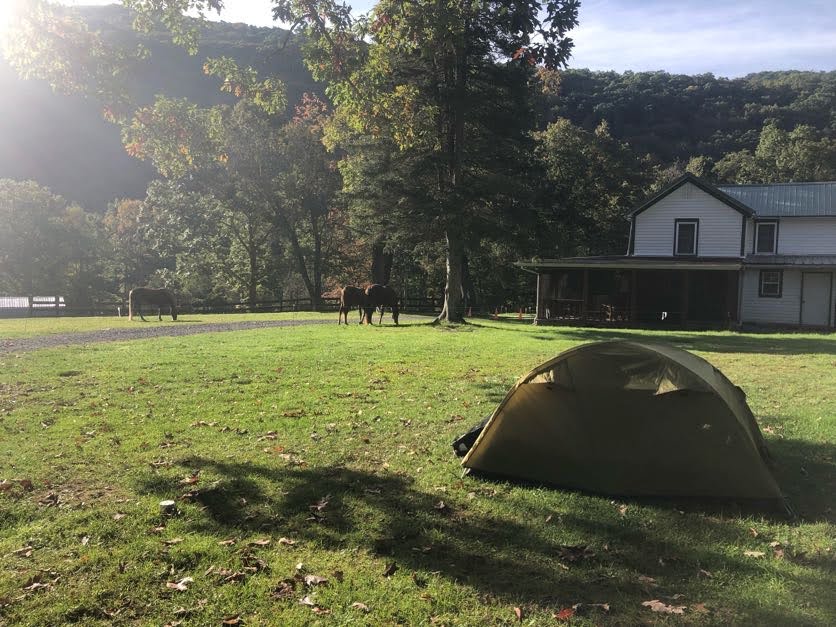
Two days ago, the trip had started out easy with a Thursday evening arrival at a horse stable campground via a shuttle service. Russ, our shuttle driver picked up two of our trio, myself and Sean, at the southern terminus of the trail. The plan was to bike back there to where our vehicle was, slightly downhill, along the 77-mile Greenbrier Trail in West Virginia over the next few days. The picturesque Greenbrier River in her fall dress would be our constant companion. We set up camp under the curious watch of the horses in their roped off areas.
Soft pink sunset hues cloaked the shapes of deer in the distance as we cycled towards Cass, the small tourist town three miles north from our campgrounds. The deer shapes grew clearer and playfully glided along with us for a few hundred yards as we pedaled along the trail. We arrived in Cass eager to stuff ourselves with the homestyle food promised to us by the Last Run Diner.

We had no moonlight to guide us back, but a cocoon of calmness cradled us and our full bellies, drawing us along with the sounds of the gentle flowing Greenbrier River on one side and the high banked limestone cliffs on other, releasing all worries about things that lurked in the dark and beyond.
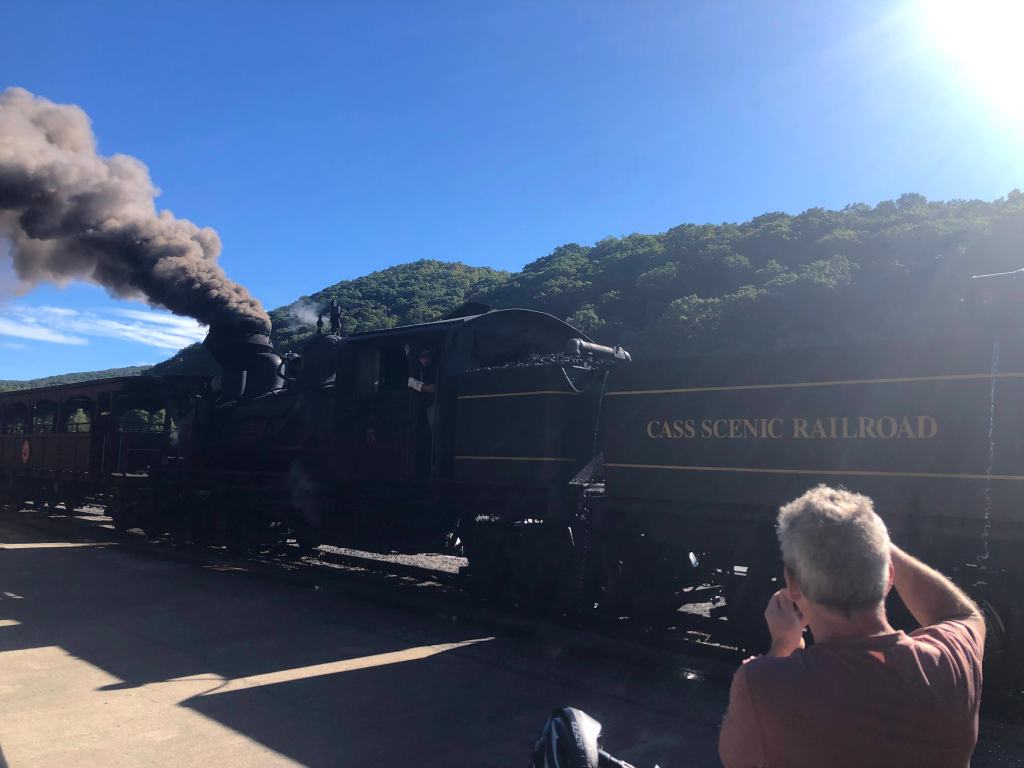
The next morning, we biked back into Cass for a hardy breakfast, and then boarded a Shay steam-powered historic 9-car passenger train that heaved us up to Bald Knob, the 3rd highest point of West Virginia. The tour guide/historian bleating over the speakers in the open-air train car framed the industrialists who began arriving in the late 19th century as hero types – hard-working businessmen who brought civility and commerce to an untamed region.
Bald mountains, empty buildings, and silent railroad tracks would have been the only things left by the Ayn Rand industrialists had it not been for the West Virginian department of tourism that purchased the land and railroad in the area a few years after the mill closed in 1960. Recognizing its value as a tourist attraction, the visionaries converted the “company housing” to upscale lodging, and marketed the trips on the trains as fun and scenic.
At the turn of the 19th century, the Luke family from Virginia was on the look-out for red spruce after perfecting a sulphite papermaking process that used this species as its most preferred wood. In 1899, John G. Luke acquired more than 67,000 acres, with this species of tree being predominant, in the Pocahontas and southern Randolph counties. Picea rubens, or red spruce is a valuable pulp wood, and it is also sought after for its resonance quality that enhances the tones of guitars and many other musical instruments. The Luke family soon convinced the Chesapeake and Ohio’s Railway to build a spur into the region where the red spruce would be harvested, sparking the lumber boom town of Cass.
West Virginia is a lesson in capitalism gone wrong. If a peppering of socialism would have existed, the residents of Cass and its surrounding area would be some of the most educated and amenity-rich residents on the planet. Instead, many are undereducated and dependent on government subsidies for basic needs. The laborious climb of the train during the two hours it took to ascend to Bald Knob reminded me of the tireless effort that went into extracting timber, and other resources.
Coal laden steam belched out of Shay Engine #4 as it ate 4 tons of coal and devoured 6,000 gallons of water for the round trip. The colors of fall exploded as we followed Leatherbark Run, a route that follows its namesake, a tributary of the Greenbrier River, up an 11% grade. The higher we climbed, the more colorful our view. The mountain ash flowers flamed their fiery crimson clusters at us as we rolled by. The yellows, oranges and reds grew more vivid with each mile we climbed.
Upon reaching the top of Bald Knob, we, along with the other 300 passengers, deboarded the train cars to breathe in a view that is most often seen from the eyes of a hawk, over 4,800 feet up. I watched as tractors moved on farmland miles below in a picture perfect valley, the only indication that I wasn’t looking at a static, painted masterpiece of art on a screen that had been dropped down at the edge of the mountainside.
That evening after dinner, we settled in around the fire, and waited for our friend Sue to arrive. Much of the enjoyment I get out of traveling to places without internet connections is not having every minute planned out and just letting things unfold. Those moments of peaceful anticipation, as we watched the sun dip below the mountains are etched in my file of lifetime memories. After watching a few headlights roll by the campground, Sue arrived after being slightly delayed by loose cows on the gravel mountain road. She had a folded-in rear view mirror as a battle scar from one of the cows that had bumped her car as it and she negotiated the space on the narrow, winding mountain road.
We eased into the next day with a cowboy breakfast back at Cass. Ready for a day of leisure and a little adventure, with only 40+ miles to ride, we left Cass with full bellies and an eye for pie. The trail scenery was splashed full of fall colors, which seemed to richen with each mile we rode.
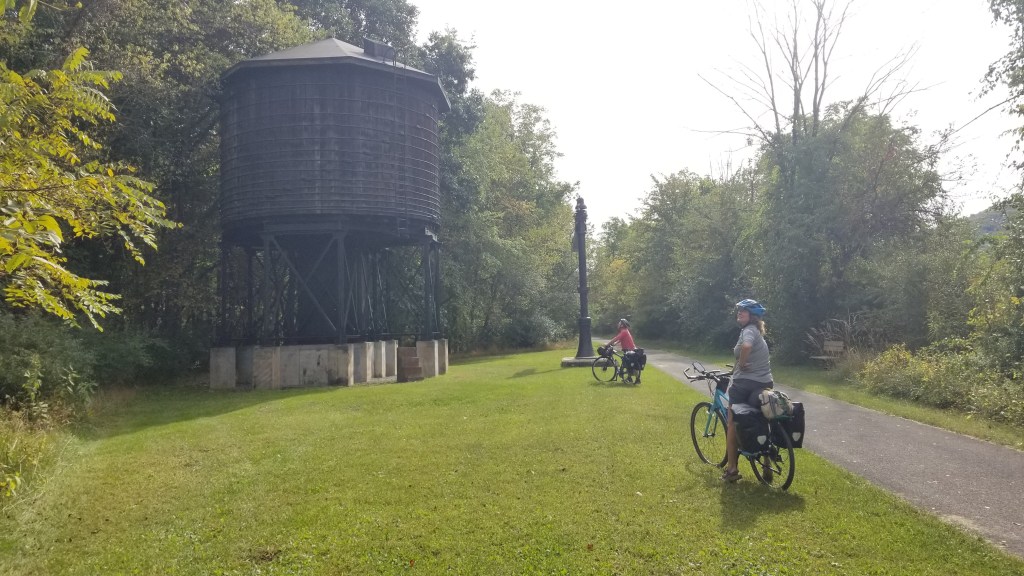
As we cycled into Marlinton, the halfway point of the trail, we had plenty of time to grab dinner before riding approximately 8 more miles to our designated campsite. Sue and I turned to find Sean a bit behind us and when he caught up, he explained that the front rack that was holding not just one of his bags, but also a bag of mine that I had pawned off on him, had dug a deep groove into his tire. A sense of guilt poked at me as I realized he had taken the bag to help me out and it was the source of this mechanical mishap.

Fortune was with us as we pedaled a short distance into town and arrived at Dirt Bean, a coffee cafe/bike shop. The owner was very helpful in getting Sean’s bike suited up with new tires. Once Sean stripped off the old tires, Sue fulfilled her usual role as the magic mechanic, suggesting the rim tape be replaced as well. Together, they made a great team, while I used my stellar photography skills to document the process. I also used my magical purchasing power to buy us coffee and poppy seed coffee cake so we didn’t starve to death in the meantime.

High spirits accompanied us to the Marlinton restaurant by the river where we were early for dinner and seated when only a few tables were taken on the outside balcony. Duck-feeding was perhaps the only past time for the residents of Marlinton, because almost every other patron had paid 50 cents to get a basket of corn to feed the ducks, numbering well over 100, that gathered below us, creating a cacophony of quacking while we waited for dinner.
Another highlight of the waiting period was a West Virginian ass special by a man who felt no shame as his ass crack hung low for all to see only a couple of tables away from where we sat. The patrons at the table next to us jokingly helped block our view so we wouldn’t have to see this wonderful sight of wonder while we ate. I did not think to get a photo to share.

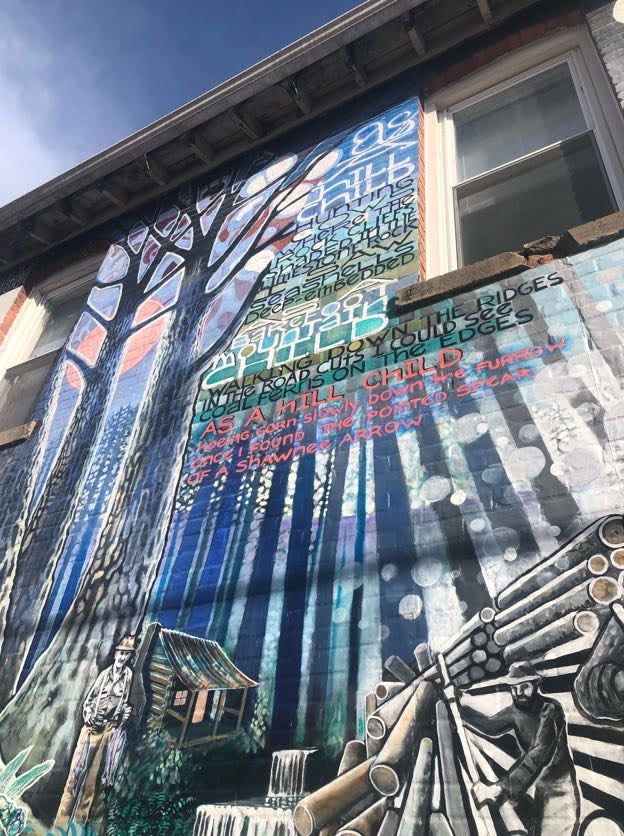
After the slooow dinner service, we set out for an easy challenge of pedaling 8 quick miles and I reminded all of us that we were to “take the switchback just past Stamping Creek Bridge” — instructions given to us from the hosts of the primitive campground that was so new, it wasn’t quite open to the public when I had made the reservations a few weeks ago. Most bridges we had passed earlier that day displayed bold black-lettered signs indicating their names, so we all knew what to watch for.
This is the place in the story where I need to back up. A few days before we left, I came across an excerpt from Derrick Jensen’s book A Language Older than Words, about communing with coyotes. It’s an excerpt I have read several times over the years because it covers a topic that I think of often when an animal around me acts in a way that seemingly coincides with something I am thinking. For example, my old dog would lead the way to a neighbor’s house that I had planned to visit while I was walking him. The first few times, probably the first MANY times, I chalked it up to coincidence and didn’t think anything of it.
As he did this more times, I grew a little suspicious, thinking that perhaps I was leading him, with subtle body language, to the house I had planned to visit. I would be very careful not to even glance or use any revealing body language towards the house that was my planned destination. It continued to happen. Finally, I started to test things further and release his leash as soon as we started walking and let him run to see where he would go. Ninety percent of the time, he would run to the neighbor’s house that I had planned to visit. The other ten percent, he’d chase a squirrel. All of us get distracted at times from our goals, and he was no different.
This is just one example of many that I have that have caused me to be somewhat suspicious that animals have some sixth sense that allows them to react to our thoughts. I’m agnostic on this topic, as I am many topics, because it’s an easier path for me to admit I don’t know. But Jensen’s stories have played into my experiences so I read them from time to time because wonder is one of the best experiences a person can have.
After reading Jensen’s excerpt, I decided to conjure up a bear in hopes of seeing one on the trip. I envisioned the bear crossing the trail from a safe distance and watching it lumber by and I also envisioned feeling calm while watching the bear. This last part was wishful thinking because I did feel nervous about seeing a bear — I felt extremely nervous about seeing a bear, but I still wanted to see one all the same.
When I told friends who had seen bears, probably many bears during their lifetime, that I had never seen a bear in the wild, I felt a twinge of embarrassment. Seeing a bear in would qualify me as a true nature afficionado and without this nature experience box checked off I felt like a mere charlatan that simply liked to spend time in nature as long as it was “safe” in areas where I wouldn’t run into wild beasts that could kill you, like bears. I came close to seeing a bear many times, often walking into an area with people pointing and telling me a bear had been “right there just a second ago”: I missed that bear. Because a second ago I was not there.
But this time I was there. I was. There. To See. The Bear.
About 5 miles into the ride, with my legs totally warmed up, and nothing filling my head but making it to the campground in the fast-disappearing sunlight, a rhythm of breathing centered me and I was in the zone that I often find myself in when I’m cycling alone.
Suddenly, a large black figure raced across the trail about 50 yards in front of us, breaking my zone. Distinctively and undeniably — a bear! I felt my heart race and my throat get tight. Pedaling became a challenge. “That was a bear!” Sue yelled.
Seconds of silence. I finally managed to respond, “I’m freaking out! Was it a cub?”
“No”, was the reply and I started to breathe again.
I continued to freak out for several more minutes. And perhaps a while longer. And perhaps awhile longer still. Finally my brain reconnected with my body and I realized my adrenaline was pushing me to ride fast, faster than I had in a long time, and I was loaded up with about 30 lbs of gear. We whizzed by a sign with photo of a bear – or was it a buffalo? I didn’t have time to look, I just kept pedaling. Everything looked like a bear. It was growing dark.
“We’ve gone almost 9 miles.” Sue alerted us a few miles later.
“Hmmmm, well the bridge should be right around here…should we turn back?”
We kept riding, into the darkness, filled with adrenaline and full stomachs and for me, a bit of angst about bears. Suddenly, it was dark — really dark. No moon. Just our bike lights without any sign of cabins that we had passed a few miles ago. Sue reported we had gone at least 12 miles since Marlinton. We turned around.
A familiar looseness to my steering grabbed my attention. “HOLD UP!” I felt my front tire with a sense of dread, confirming what I already knew. The tire was flat.
Sue and Sean doubled back to help and as I reached for my spare tube, panic overtook me. I had swapped it out for smaller tire size a couple of weeks ago for a multi-day tour on a different bike. I had forgotten to swap it back. My tube was for my road bike and was way too small for my touring tires. We were miles from nowhere and it was getting cold and dark.
Sue to the rescue! Only a few hours ago, she had purchased a tube at Dirt Bean, and it was the exact size I needed. Once again, her magical mechanical skills accomplished a quick tire change and we resumed our search for what was now referred to as Campcantfindit. We had ridden more than 6 miles past what we eventually learned was Stamping Creek Bridge. After many frantic calls and texts when we were in range of cellular coverage, the three owners of the campsite guided us to the bridge that had no sign on it, but instead had an interpretive sign near it with what had looked like a bear but was actually a buffalo, indicating Stamping Creek.
We found the trail that had been described as a switchback and finally arrived at the campsite, where thankfully, we were the only campers for the night. The owners showed up and helped us get settled in.
So much for an easy 45 mile day. We had ridden 60 miles according to Sue’s odometer!

We all moved a little slower the next morning. The sunshine spurred us on and as we left, we glanced up at the “switchback” we had finally found in the dark the night before.

Not much more than a steep drainage flow trail suitable for rabbits, it was no wonder we had zoomed past it the first time, just as the last threads of dusk were disappearing. We had passed it three more times in the dark before seeing it. A lesson learned about West Virginian vernacular. The term switchback in Ohio is an alternative route for a traveler going up or down a steep grade. The route switches direction several times over a longer distance to decrease the grade. This pathway did not accomplish any of that; it was a straight path down the hillside. My guess is there are a few other differences like this between the vernacular of the two states.
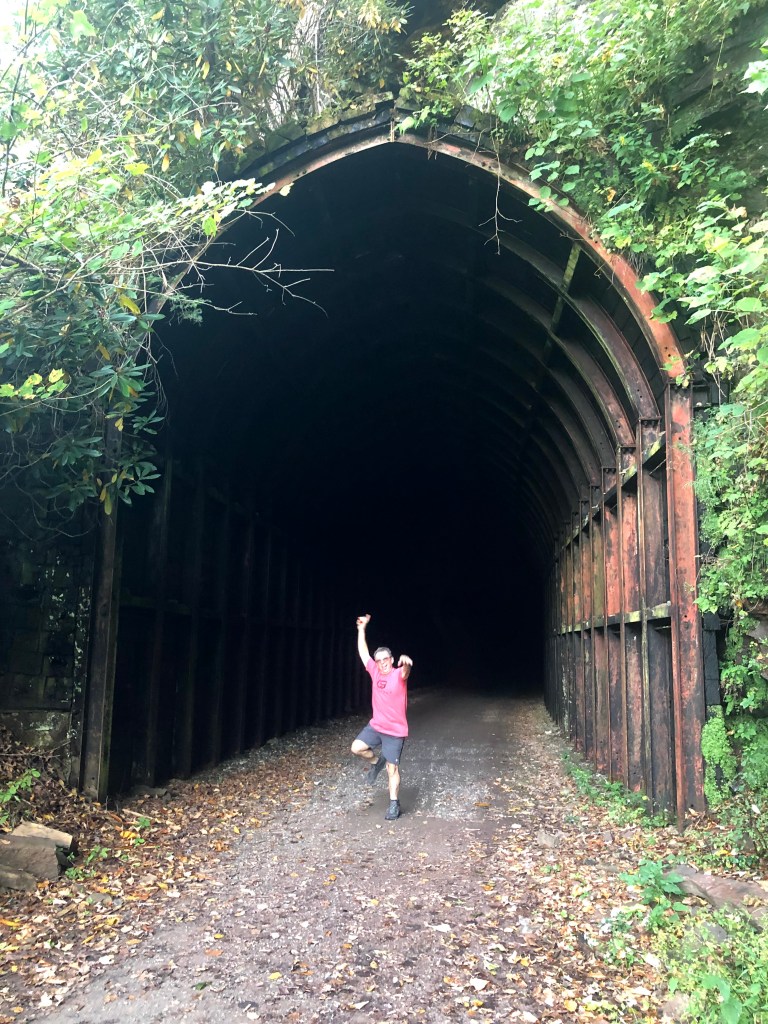
The second day of riding brought much less drama, which is what we all needed. We met a United States geologist couple using a hammer to look for fossils just outside the second tunnel of the trail. The hammer’s manufacturing die had been forged and tested by none other than our magical mechanic Sue, whose day job involves forging specialty tools. The couple shared some coral fossils that were especially noteworthy in that area with us. They told us that the type of rock was described as a sandy limestone.

I may have been slightly anemic on the second day, but the sense of adventure was enough to keep me going. A lot less outcroppings of communities along the way reminded us that we were deep in the wildness of West Virginia.
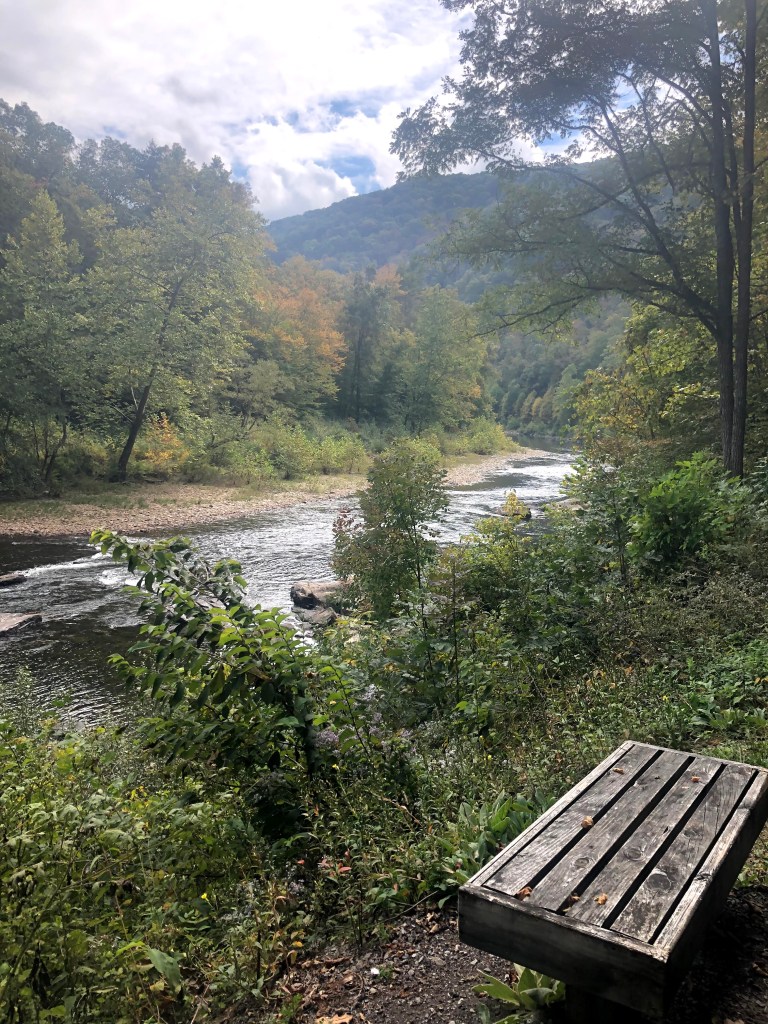
Late in the afternoon, the clouds moved in, the temperatures dropped, and a few drops of rain reminded us it was fall. We arrived at our vehicle, eager to get warm showers and a celebratory meal. Full of gratitude for a soft mattress to fall into, I slept like the dead and didn’t dream of bears once.

 OlentangyWay


